Massachusetts Striped Bass Spring Run (2026): Trends, Timing & What to Expect
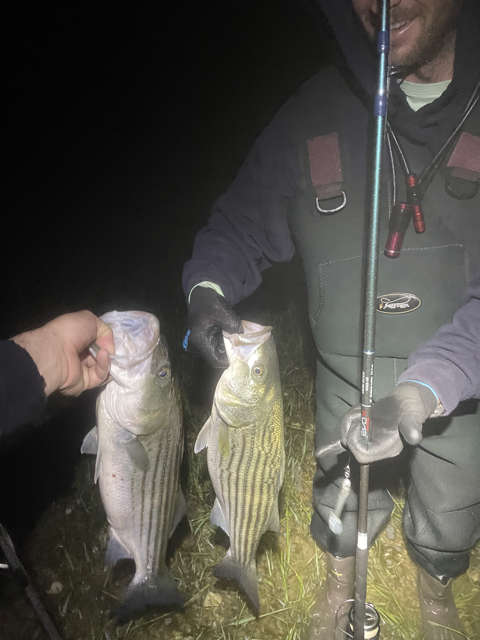
Two surf anglers stand along a Massachusetts shoreline during the spring striped bass run, each holding a large striped bass during a successful outing.
Massachusetts Striped Bass Spring Run Trends (2026 Outlook)
It wasn’t long ago that the start of the spring striped bass run in Massachusetts meant one thing, schoolies. That first push of fish was almost always smaller bass. Reliable. Predictable. Everywhere. But in recent years, that script has flipped.
Now, it’s increasingly common to see slot and above-slot striped bass showing up first across much of New England’s coastal waters. That raises a bigger question: Are striped bass changing their migration patterns, and should we be concerned?
A Shift in Spring Run Timing and Size
The spring run in Massachusetts has become noticeably less predictable. Even after relatively mild winters, we’ve seen:
Delayed starts
Slower early action
But better average fish size right out of the gate
In 2025, striped bass didn’t show in meaningful numbers until late April, and the bite didn’t really turn on until early May. The upside? Most of the early fish were in the mid-20 to mid-30 inch class, solid slot fish, not schoolies. That’s great for anglers in the short term. But zoom out, and it tells a different story.
Where Did All the Schoolie Stripers Go?
There was a time, especially in the early to mid-2010s, when schoolie striped bass dominated the spring run. Every estuary, river bend, and current seam seemed loaded with fish. In many cases, some of those fish even held over through the winter in Massachusetts waters. That consistency wasn’t random. It was backed by strong spawning years, especially 2011 and 2015, in the Chesapeake Bay, the primary spawning ground for Atlantic striped bass. Data from the Maryland Department of Natural Resources highlights just how productive those years were compared to the long-term average.
When you line that up with logs from Massachusetts anglers, a clear pattern emerges:
Strong spawn years = more schoolies and better fishing overall
Weak spawn years = fewer fish, especially early in the season
That’s exactly what we’re seeing now.
What This Means for the Fishery
The drop in schoolie numbers isn’t just about slower action, it’s a warning sign. Fewer young fish in the system means:
Less consistent fishing
More pressure on larger, breeding-size fish
Long-term concerns for the striped bass fishery
At the same time, we’re still benefiting from those strong 2011 and 2015 year classes. Fish from those spawns are now:
35 to 45 inches
Often above the legal slot limit in Massachusetts
These are the fish fueling today’s early-season bite. But they won’t carry the fishery forever.
Spring 2026 Striped Bass Forecast (Massachusetts)
Looking ahead to spring 2026, expect more of the same pattern.
What to Expect:
Expect larger fish to arrive first, with slot to over-slot bass making up the early push. At the same time, don’t expect much in terms of numbers early on. Schoolie action will likely be limited, especially in rivers and estuaries where those younger year classes have been noticeably lacking.
With another colder winter behind us, the overall start should be slow and drawn out. That doesn’t mean there won’t be fish, it just means they’ll be more spread out, less aggressive, and more dependent on the right conditions lining up.
The first consistent activity will come from holdover striped bass, which are already keyed in on early bait like herring. These fish tend to set the tone early in the season and are often the most predictable bite before the migratory push begins.
As for migratory fish, timing becomes everything.
You’re looking for that first real wave of bass pushing into Massachusetts waters by late April, often marked by fish showing up with sea lice, a clear sign they’ve recently moved in. But those first arrivals don’t always mean instant action.
What matters more is when those fish settle into feeding patterns, which typically lines up with improving water temperatures, bait presence, and favorable tides, usually building into early May.
The anglers who do best during this stretch aren’t just waiting for fish to show up, they’re tracking progression. Each push of fish builds on the last, and recognizing that shift is what turns a slow start into a productive one.
Key Timing Windows:
New Moon: April 17
Full Moon: May 1
If conditions line up, that late-April window before the full moon could be the first real push of migratory fish.
How to Find Early Season Stripers
Early in the season, success comes down to reading signs, not just fishing spots. Focus on:
Bait presence (especially herring runs and silversides)
Bird activity like ospreys
Estuaries and areas holding overwintered fish
Water temperature differences and tidal impacts
The biggest mistake anglers make this time of year is fishing where fish should be, instead of where they actually are. Be willing to move. If a spot isn’t producing, don’t wait it out, adjust and find active fish.
One of the most consistent early-season patterns is fishing an outgoing tide at night, when water that’s been warmed by the sun during the day drains out of estuaries and back into colder surrounding water. That temperature change can concentrate bait and pull in feeding striped bass. Even a 1–2 degree difference in water temperature can make a noticeable impact this time of year. Areas like mud flats, back estuaries, and protected shorelines tend to warm faster and are often where the first real bites happen.
Early in the season, it’s not about grinding spots, it’s about identifying triggers. Water temperature, bait movement, and current flow matter more than structure right now. If those three things aren’t lining up, neither are the fish. What most anglers overlook is how short these windows can be. The bite might only last 30–60 minutes around a key part of the tide, if you’re not there for it, it can feel like nothing is happening. Pay close attention to areas where shallow water dumps into slightly deeper channels, especially near marsh drains and estuary mouths. These small transitions often concentrate both bait and bass on that outgoing flow. Early-season success doesn’t come from fishing harder, it comes from adjusting faster.
Conservation Matters More Than Ever
With more large fish and fewer juveniles in the system, proper handling matters more than ever. The fish we’re catching early in the season right now, especially those over-slot bass, are often part of a limited number of strong year classes. How they’re handled directly impacts the future of the fishery.
For over-slot striped bass:
Keep fish in the water whenever possible
Minimize handling time
Use appropriately strong gear to reduce fight time
Release fish quickly, upright, and with intention
A lot of mortality doesn’t happen at the moment of release, it happens after. Fish that are overplayed, mishandled, or stressed in colder water can swim off and still not recover. Early in the season, even when water temperatures are still low, fish can be sensitive to long fights and excessive handling. The goal isn’t just to land the fish, it’s to make sure it swims away strong. Because right now, these larger fish aren’t just the best part of the bite, they’re carrying the fishery.
Final Thoughts on the 2026 Spring Run
The Massachusetts striped bass spring run is still one of the best fisheries in the country, it just looks a little different than it did 10–15 years ago. Fewer schoolies, more quality fish early, and a heavier reliance on strong year classes are shaping what we’re seeing today. If you adjust to that, focusing less on numbers and more on timing, conditions, and fish behavior, you’ll stay on fish while others struggle to figure it out.
Learn to Stay on Fish This Spring
If you’re trying to shorten the learning curve, the biggest difference-maker is understanding why fish are where they are, not just where to stand. That’s exactly what I focus on.
Through FishMass guided surf fishing trips, I break down:
How to read water in real time
How to adjust based on tides, bait, and conditions
How to consistently find fish instead of hoping they show up
Trips are based around the South Shore, Cape Cod, Martha’s Vineyard, and Nantucket, and are always planned around current conditions, not fixed locations.
If you’d rather put the time in before the season starts, I also offer off-season advising focused specifically on New England surf fishing. It’s built to help you connect the dots so when the fish show up, you’re ready.
If you want to fish smarter this season instead of starting from scratch, this is the time to get dialed in.
Click the banner at the top of the page to get in touch.